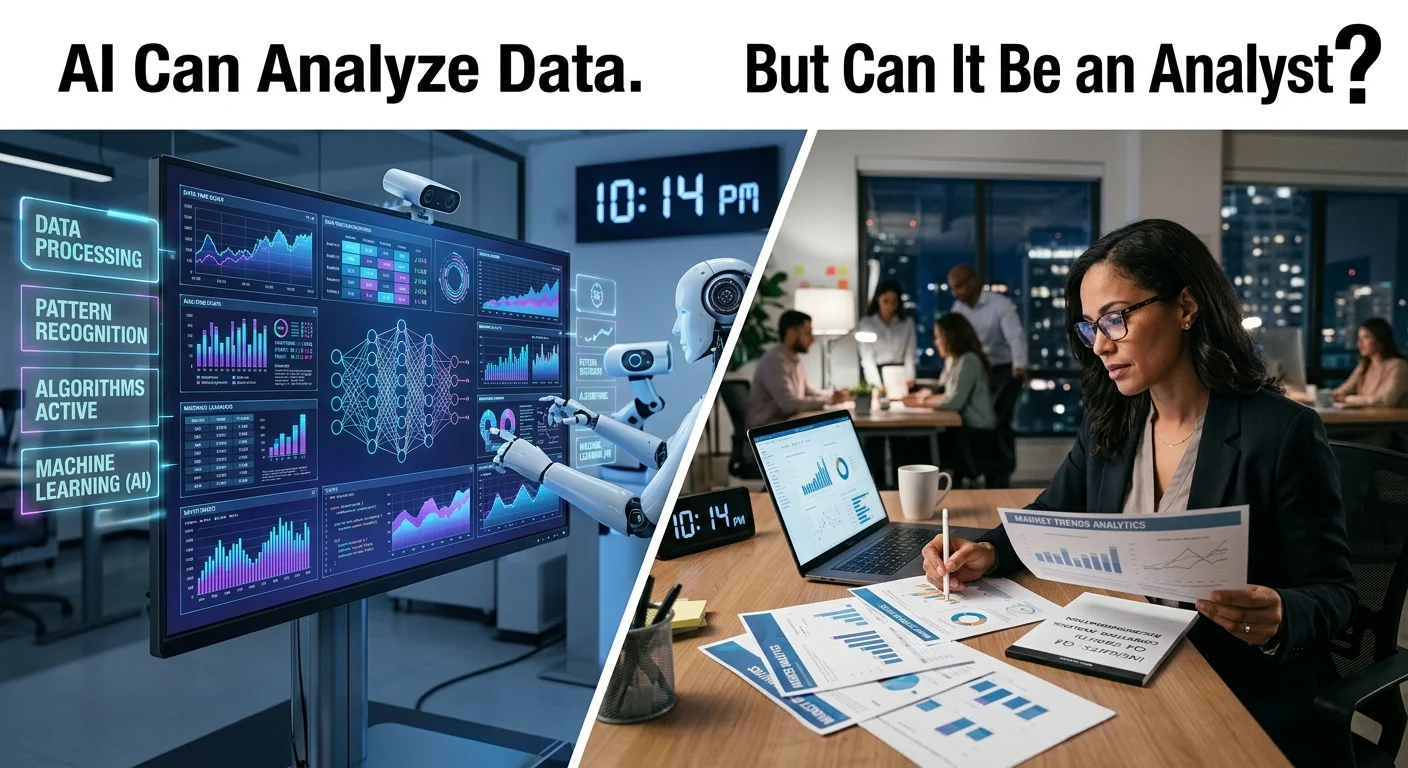
AI isn’t killing Data Analytics. It’s changing what being an Analyst means
Every few months, another headline appears:
- “AI is coming for data analysts.”
- “Why data analysts won’t matter in 2027.”
- “AI will write all your SQL soon.”
The think pieces pile up. The LinkedIn posts multiply and somewhere someone declares that in a few years companies won't need humans to analyse data anymore.
There is a real reason for the anxiety.
AI can already write SQL in seconds. It can generate Python, clean datasets, identify patterns, create visualisations and produce a first draft of a report before you've finished your coffee.
But there's a problem with the argument that this means data analysts are disappearing.
It confuses the tasks an analyst performs with the role an analyst plays. AI is getting exceptionally good at performing parts of analytical work but that doesn't mean the entire profession is becoming obsolete.
What is happening is more interesting: the role is changing and the most valuable parts of it are shifting.
What Artificial Intelligence (AI) does exceptionally well
Let's be honest about AI's strengths.
If your job consists primarily of:
- Writing repetitive SQL queries.
- Cleaning straightforward datasets.
- Generating standard reports.
- Building routine dashboards.
- Summarizing trends and producing basic visualizations,
then yes, your work is increasingly exposed to automation and this isn't hypothetical. AI can produce a SQL query almost instantly. It can suggest Python code, explain statistical concepts, identify anomalies and generate a dashboard structure.
So if the value you provide is simply:
“Give me a question and I'll pull the numbers.” then that value is becoming cheaper.
But that has never been the entire job of a good analyst.
The part that still requires Judgement
Think of it like a calculator versus a detective:
• AI is like a very powerful calculator: It can process enormous amounts of information and identify patterns extremely quickly but identifying a pattern isn't the same as understanding why it matters or what should be done about it.
• Humans are the detectives. An analyst can develop a hunch, notice that something doesn't make sense and investigate further. More importantly they can connect what they find to the business context and the consequences of getting it wrong.
Consider a manager saying, “Show me this month's sales numbers.” An automated system can retrieve the numbers. But an analyst should be thinking:
- Why do they need them?
- Is there a board meeting coming up?
- Did revenue suddenly change?
- Is management concerned about a particular region?
- Did a competitor launch something?
- Did the definition of the metric change?
- Is there a problem hidden inside the overall number?
The difference is important.
AI can analyze the data you give it. The analyst has to determine whether the data, question, assumptions and interpretation actually make sense and that goes further than business context.
Technical correctness is not the same as analytical correctness. Suppose AI tells you:
“Revenue increased by 18%.” It may have written perfectly valid SQL. The calculation may be mathematically correct. But what if:
- Refunds weren't included?
- Duplicate transactions were present?
- One region stopped reporting?
- The company changed its definition of revenue?
- The comparison period isn't actually comparable?
- A major customer was counted twice?
The SQL can be correct while the conclusion is wrong. That's why knowing how to write SQL isn't enough. You need to know enough about the data and the business to challenge the result.
The big takeaway: AI can surface unusual patterns and suggest questions. The analyst still has to determine which questions matter, investigate the context and decide what the findings actually mean.
Think of AI as a very powerful analytical assistant
A useful way to think about it isn't AI vs. analyst but Analyst + AI.
AI can help you move faster:
It can write the first SQL query, it can suggest a cleaning approach, it can generate Python, it can challenge your assumptions, it can identify patterns you might have missed and it can help explain a statistical method.
But you still need to know enough to ask, “Is this correct?” and more importantly, “Does this make sense?” That distinction is becoming increasingly important.
What the job market is actually changing
The biggest risk isn't necessarily that all data analysts disappear. It is that the definition of an entry-level analyst changes. Companies may need fewer people whose primary responsibility is producing routine reports and dashboards.
At the same time, they may place greater value on people who can:
- Work with ambiguous business problems.
- Investigate data quality issues.
- Understand business processes.
- Communicate with stakeholders.
- Validate analytical results.
- Interpret trends.
- Use AI effectively.
- Translate findings into decisions.
- Take responsibility for the analysis they produce
In other words, the mechanical part of the job is becoming cheaper.
The judgement layer becomes more important.
This doesn't mean Technical Skills no longer matter
This is another misconception worth avoiding.
Don't hear, “AI can write SQL so SQL doesn't matter.” It does. In fact, you need enough SQL knowledge to recognize when AI has written bad SQL scripts. You need enough Python to understand what generated code is actually doing. You need enough statistics to recognize when a conclusion isn't justified. You need enough Power BI knowledge to know whether the metric being visualized actually represents what the business thinks it represents.
AI doesn't eliminate the need to understand your tools. It changes how you use them.
You move from manually doing everything to I know what needs to be done, I can use AI to accelerate it and I can verify the result.” That's a very different skill set.
The Real Career Shift
The analyst of the future probably isn't simply the person who can write the most SQL. It's the person who can sit between the business problem, the data, AI, the analysis, the decision and make sure the entire chain makes sense.
Instead of simply reporting, “Sales fell 12%." The valuable analyst asks, “Why did sales fall?” Then, “Is the decline real?” Then, “What changed?” Then, “Which customers, products or regions are responsible?” Then, “What evidence supports the explanation?” and finally, “What decision could this information support?”
That's analysis. The dashboard is only one part of it.
What this means for your career
If you're building a data career right now, here's what this means practically.
Don't make your goal to simply master SQL, Excel and Power BI. Learn them well, absolutely but don't stop there. Those are foundational skills but AI is making some of the tasks performed with those tools faster and easier to automate.
Learn how the business actually works, understand where the data comes from, learn how metrics are defined, learn to recognize bad data, learn statistics well enough to question conclusions, learn to communicate findings to people who don't care about SQL, learn to ask better questions and use AI aggressively but critically because the valuable skill is knowing whether the answer deserves to be trusted.
The real question isn't whether AI can analyze data. It obviously can.
The better question is, Can you understand the problem, interrogate the output, recognize when something is wrong and turn the result into something meaningful for the business? That is the direction the profession is moving in.
Some analytical tasks will disappear, some roles will shrink, some entry level work will become more automated and new expectations will emerge.
That's not a reason to ignore AI. It's a reason to learn how to work with it.
Comments (0)
No comments yet.